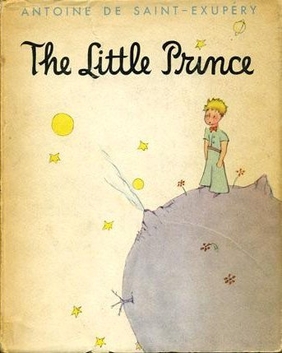
The novella is the fourth most-translated book in the world and was voted the best book of the 20th century in France. Translated into more than 250 languages and dialects (as well as
Braille), selling nearly two million copies annually with sales totaling over 140 million copies worldwide, it has become
one of the best-selling books ever published.
After the outbreak of the
Second World War Saint-Exupéry was exiled to North America. In the midst of personal upheavals and failing health, he produced almost half of the writings for which he would be remembered, including a tender tale of loneliness, friendship, love, and loss, in the form of a young prince fallen to Earth. An earlier memoir by the author had recounted his aviation experiences in the
Sahara Desert, and he is thought to have drawn on those same experiences in
The Little Prince.
The Little Prince is a poetic tale, with watercolour illustrations by the author, in which a pilot stranded in the desert meets a young prince fallen to Earth from a tiny
asteroid. The story is philosophical and includes social criticism, remarking on the strangeness of the adult world. It was written during a period when
Saint-Exupéry fled to North America subsequent to the
Fall of France during the
Second World War, witnessed first hand by the author and captured in his memoir
Flight to Arras. The adult fable, according to one review, is actually "...an allegory of Saint-Exupéry's own life—his search for childhood certainties and interior peace, his mysticism, his belief in human courage and brotherhood, and his deep love for his wife Consuelo but also an allusion to the tortured nature of their relationship."
Though ostensibly styled as a
children's book,
The Little Prince makes several observations about life and human nature. For example, Saint-Exupéry tells of a
fox meeting the young prince during his travels on Earth. The story's essence is contained in the lines uttered by the fox to the little prince: "One sees clearly only with the heart. What is essential is invisible to the eyes." Other key thematic messages are articulated by the fox, such as: "You become responsible, forever, for what you have tamed." and "It is the time you have lost for your rose that makes your rose so important." The fox's messages are arguably the book's most famous quotations because they deal with human relationships.
Plot
The narrator explains that, as a young boy, he once drew a picture of a
boa constrictor with an
elephant digesting in its stomach; however, every adult who saw the picture would mistakenly interpret it as a drawing of a hat. Whenever the narrator would try to correct this confusion, he was ultimately advised to set aside drawing and take up a more practical or mature hobby. The narrator laments the lack of creative understanding displayed by adults. As noted by the narrator, he could have had a great career as a painter, but this opportunity was crushed by the misunderstanding of the adults.
Now an adult himself, the narrator has become a pilot, and, one day, his plane crashes in the
Sahara, far from civilization. Here, the narrator is greeted by a young boy whom he refers to as "the little prince". The little prince asks the narrator to draw a sheep. The narrator first shows him his old picture of the elephant inside the snake, which, to the narrator's surprise, the prince interprets correctly. After three failed attempts at drawing a sheep, the narrator simply draws a box in his frustration, claiming that the box holds a sheep inside. Again, to the narrator's surprise, the prince exclaims that this is exactly the picture he wanted. The narrator says that the prince has a strange habit of avoiding directly answering any of the narrator's questions. The prince is described as having golden hair, a scarf, and a lovable laugh.
Over the course of eight days stranded in the desert, as the narrator attempts to repair his plane, the little prince recounts the story of his life, often caused by his discussion of the sheep. The prince begins by describing life on his tiny home planet: in effect, an
asteroid the size of a house (which the narrator believes to be the one known as
B-612). The asteroid's most prominent features are three minuscule
volcanoes (two active, and one
dormant or extinct) as well as a variety of plants. The prince describes spending his earlier days cleaning the volcanoes and weeding unwanted seeds and sprigs that infest his planet's soil; in particular, pulling out
baobab trees that are constantly trying to grow and overrun the surface. The prince appears to want a sheep to eat the undesirable plants, until the narrator informs him that a sheep will even eat roses with thorns. Upon hearing this, the prince tells of his love for a mysterious rose that began growing on the asteroid's surface some time ago. The prince says he nourished the rose and listened to her when she told him to make a screen or glass globe to protect her from the cold wind. Although the prince fell in love with the rose, he also began to feel that she was taking advantage of him, and he resolved to leave the planet to explore the rest of the universe. Although the rose finally apologized for her
vanity, and the two reconciled, she encouraged him to go ahead with his journey and so he traveled onward.
The prince has since visited six other asteroids, each of which was inhabited by a foolish, narrow-minded adult, including: a king with no subjects; a conceited man, who believed himself the most admirable person on his otherwise uninhabited planet; a drunkard who drank to forget the shame of being a drunkard; a businessman who endlessly counted the stars and absurdly claimed to own them all; a lamplighter who mindlessly extinguished and relighted a lamp every single minute; and an elderly
geographer, so wrapped up in theory that he never actually explored the world that he claimed to be mapping. When the geographer asked the prince to describe his home, the prince mentioned the rose, and the geographer explained that he does not record "
ephemeral" things, such as roses. The prince was shocked and hurt by the revelation. The geographer recommended that the prince next visit the planet
Earth.
Since the prince landed in a desert, he believed that Earth was uninhabited. He then met a yellow snake that claimed to have the power to return him to his home, if he ever wished to return. The prince next met a desert flower, who told him that she had only seen a handful of men in this part of the world and that they had no roots, letting the wind blow them around and living hard lives. After climbing the highest mountain he had ever seen, the prince hoped to see the whole of Earth, thus finding the people; however, he saw only the enormous, desolate landscape. When the prince called out, his echo answered him, which he interpreted as the mocking voices of others. Eventually, the prince encountered a whole row of rosebushes, becoming downcast at having once thought that his own rose was unique. He began to feel that he was not a great prince at all, as his planet contained only three tiny volcanoes and a flower that he now thought of as common. He lay down in the grass and wept, until a
fox came along. The fox desired to be tamed and explained to the prince that his rose really was indeed unique and special, because she was the object of the prince's love. The fox also explained that, in a way, the prince had tamed the rose, and that this is why the prince was now feeling so responsible for her. The prince then took time to tame the fox, though the two ultimately parted ways, teary-eyed. The prince next came across a railway switchman, who told him how passengers constantly rushed from one place to another aboard trains, never satisfied with where they were and not knowing what they were after; only the children among them ever bothered to look out the windows. A merchant then talked to the prince about his product, a pill that eliminated thirst, which was very popular, saving people fifty-three minutes a week. The prince replied that he would instead gladly use that extra time to go around finding fresh water.
Back in the present moment, it is the eighth day after the narrator's plane-crash and the narrator is dying of thirst; fortunately, he and the prince together find a well. The narrator later finds the prince talking to the snake, discussing his return home and eager to see his rose again, who he worries has been left to fend for herself. The prince bids an emotional farewell to the narrator and states that if it looks as though he has died, it is only because his body was too heavy to take with him to his planet. The prince warns the narrator not to watch him leave, as it will make him upset. The narrator, realizing what will happen, refuses to leave the prince's side; the prince consoles the narrator by saying that he only need look at the stars to think of the prince's lovable laughter, and that it will seem as if all the stars are laughing. The prince then walks away from the narrator and allows the snake to bite him, falling without making a sound.
The next morning, the narrator tries to look for the prince, but is unable to find his body. The story ends with the narrator's drawing of the landscape where the prince and the narrator met and where the snake took the prince's life. The narrator requests that anyone in that area encountering a small young man who refuses to answer questions should contact the narrator immediately.
Tone and writing style
The story of
The Little Prince is recalled in a sombre, measured tone by the pilot-narrator, in memory of his small friend, "a memorial to the prince—not just to the prince, but also to the time the prince and the narrator had together".
The Little Prince was created when
Saint-Exupéry was "...an expatriate and distraught about what was going on in his country and in the world." It was written during his 27-month sojourn in North America, almost as a sort of
credo, "carefully employing the expressions of despair, loneliness, and triumph throughout its plotline."
According to one analysis, "the story of the Little Prince features a lot of fantastical, unrealistic elements... You can't ride a flock of birds to another planet... The fantasy of the Little Prince works because the logic of the story is based on the imagination of children, rather than the strict realism of adults."
An exquisite literary perfectionist akin to the 19th century French poet
Stéphane Mallarmé, Saint-Exupéry produced draft pages "covered with fine lines of handwriting, much of it painstakingly crossed out, with one word left standing where there were a hundred words, one sentence substitut[ing] for a page...." He worked "long hours with great concentration". According to the author himself it was extremely difficult to start his creative writing processes.Biographer Paul Webster wrote of the aviator-author's style "Behind Saint-Exupéry's quest for perfection was a laborious process of editing and rewriting which reduced original drafts by as much as two-thirds of their length. The French author frequently wrote at night, usually starting about 11 p.m. accompanied by a tray of strong black coffee. In 1942 Saint-Exupéry related to his American English teacher, Adèle Breaux, that at such a time of night he felt "free" and able to concentrate, "writing for hours without feeling tired or sleepy" until he instantaneously dozed off. He would wake up later, in daylight, still at his desk with his head on his arms. Saint-Exupéry stated it was the only way he could work, as once he started a writing project it became an obsession.
Inspirations
Events and characters

Saint-Exupéry next to his crashed Simoun (lacking an all-critical radio) after crashing into the Sahara about 3 am during an air race to
Saigon,
Vietnam. His survival ordeal was about to begin (Egypt, 1935).
In
The Little Prince, its narrator, the pilot, talks of being stranded in the desert beside his crashed aircraft. This account clearly drew on Saint-Exupéry's own experience in the Sahara, an ordeal described in detail in his 1939 memoir
Wind, Sand and Stars (original French:
Terre des hommes).
[13]
On December 30, 1935, at 02:45 am, after 19 hours and 44 minutes in the air, Saint-Exupéry, along with his copilot-navigator André Prévot, crashed in the Sahara desert. They were attempting to break the speed record for a Paris-to-Saigon flight in a then-popular type of air race, called a
raid, and win a prize of 150,000
francs.
[26] Their plane was a
Caudron C-630 Simoun,
[Note 5] and the crash site is thought to have been near to the
Wadi Natrun valley, close to the
Nile Delta.
Both miraculously survived the crash, only to face rapid dehydration in the intense desert heat.
[28] Their maps were primitive and ambiguous. Lost among the sand dunes with a few grapes, a thermos of coffee, a single orange, and some wine, the pair had only one day's worth of liquid. They both began to see
mirages, which were quickly followed by more vivid
hallucinations. By the second and third days, they were so dehydrated that they stopped sweating altogether. Finally, on the fourth day, a
Bedouin on a camel discovered them and administered a native rehydration treatment that saved Saint-Exupéry and Prévot's lives.
[26]
The prince's home, "Asteroid B-612", was likely derived as a progression of one of the planes Saint-Exupéry flew as an
airmail pilot, which bore the serial number "A-612". During his service as a mail pilot in the Sahara, Saint-Exupéry had viewed a
fennec (desert sand fox), which most likely inspired him to create the fox character in the book. In a letter written to his sister Didi from the Western Sahara's
Cape Juby, where he was the manager of an airmail stopover station in 1928, he tells of raising a fennec which he adored.
[citation needed]
In the novella the fox, believed to be modelled after the author's intimate New York City friend Silvia Hamilton Reinhardt, tells the prince that his rose is unique and special, because she is the one that he loves.
[29] The novella's iconic phrase, "One sees clearly only with the heart", is believed to have been suggested by Silvia Hamilton.
The fearsome, grasping
baobab trees, researchers have contended, were meant to represent
Nazism attempting to destroy the planet.
[29] The little prince's reassurance to the pilot that his dying body is only an empty shell resembles the last words of Antoine's dying younger brother François, who told the author, from his deathbed: "Don't worry. I'm all right. I can't help it. It's my body".
[30]
The Rose[edit]

The Rose in
The Little Princewas likely inspired by Saint-Exupéry's Salvadoran wife, Consuelo (Montreal, 1942).
Many researchers believe that the prince's petulant, vain rose was inspired by Saint-Exupéry's
Salvadoran wife
Consuelo,
[29] with the small home planet being inspired by her small home country
El Salvador, also known as "The Land of Volcanoes". Despite a raucous marriage, Saint-Exupéry kept Consuelo close to his heart and portrayed her as the prince's Rose whom he tenderly protects with a wind screen and under a glass dome on his tiny planet. Saint-Exupéry's infidelity and the doubts of his marriage are symbolized by the vast field of roses the prince encounters during his visit to Earth.
[13]
This view of Consuelo was described by biographer Paul Webster who stated she was "the muse to whom Saint-Exupéry poured out his soul in copious letters..... Consuelo was the rose in
The Little Prince. "I should have judged her by her acts and not by her words," says the prince. "She wrapped herself around me and enlightened me. I should never have fled. I should have guessed at the tenderness behind her poor ruses."
[12]
The Prince[edit]
Saint-Exupéry may have drawn inspiration for the prince's character and appearance from his own self as a youth, as during his early years friends and family called him
le Roi-Soleil (the Sun King) due to his golden curly hair. The author had also met a precocious eight-year-old with curly blond hair while residing with a family in
Quebec City, Canada in 1942,
Thomas De Koninck, the son of philosopher
Charles De Koninck.
[35] Another possible inspiration for the little prince has been suggested as Land Morrow Lindbergh, the young, golden-haired son of the pioneering American aviator
Charles Lindbergh and his wife
Anne Morrow all of whom met him during an overnight stay at their
Long Island home in 1939.
[37][Note 6]
Some have seen the prince as a Christ figure, as the child is sin-free and "believes in a life after death", subsequently returning to his personal heaven.
[38] When
Lifephotojournalist
John Phillips questioned the author-aviator on his inspiration for the child character, Saint-Exupéry told him that one day he looked down on what he thought was a blank sheet and saw a small childlike figure. “I asked him who he was,” Saint-Ex said. “I’m the Little Prince,” was the reply.
[39]
One of Saint-Exupéry's earliest literary references to a small prince is to be found in his second news dispatch from
Moscow, dated May 14, 1935. In his writings as a special correspondent for
Paris-Soir the author described his transit from France to the U.S.S.R. by train. Late at night during the train trip he ventured from his first class accommodation into the third class carriages, where he came upon large groups of Polish families huddled together, returning to their homeland. His commentary not only described a diminutive prince, but also touched on several other themes Saint-Exupéry incorporated into various philosophical writings:
[40]
| “ | I sat down [facing a sleeping] couple. Between the man and the woman a child had hollowed himself out a place and fallen asleep. He turned in his slumber, and in the dim lamplight I saw his face. What an adorable face! A golden fruit had been born of these two peasants..... This is a musician's face, I told myself. This is the child Mozart. This is a life full of beautiful promise. Little princes in legends are not different from this. Protected, sheltered, cultivated, what could not this child become? When by mutation a new rose is born in a garden, all gardeners rejoice. They isolate the rose, tend it, foster it. But there is no gardener for men. This little Mozart will be shaped like the rest by the common stamping machine.... This little Mozart is condemned. |